
Breed Library
Everything your Toller does at home, he was built to do on a marsh
A double exposure is usually just a pretty effect. This one works more like a diagram. Every element blended into the dog — the ducks, the cold water, the turning leaves, the reeds — is a working part of the breed, and not one of them has gone away just because there is a sofa now.
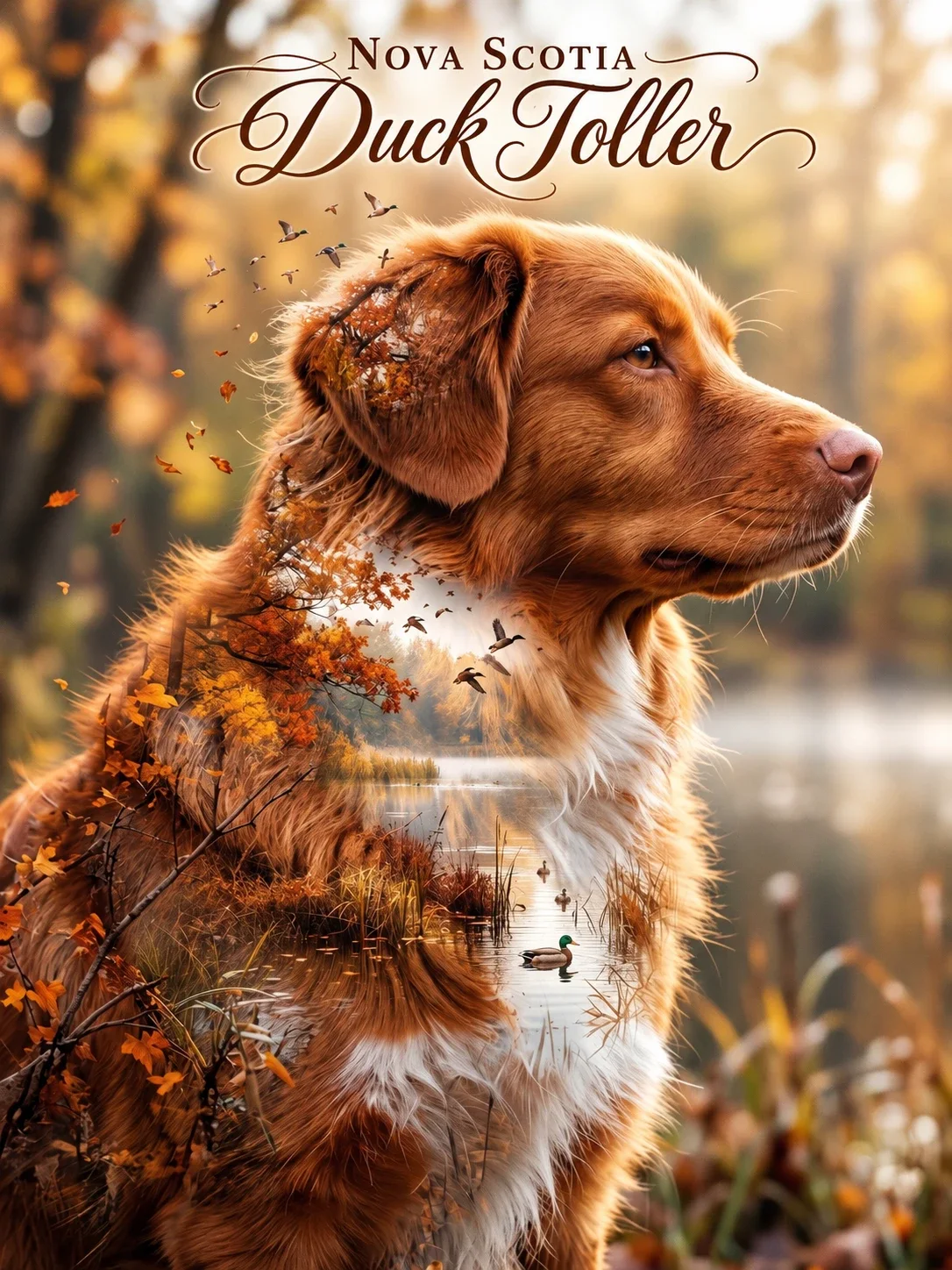
The ducks are not prey. They are the audience
Start with the birds, because they are the part everybody reads wrong. A Toller on a shoreline is not hunting those ducks. He is performing for them.
The whole invention of this breed is that the dog works before the shot rather than after it. Hidden in the reeds, a hunter throws a stick along the water's edge; the dog dashes after it, turns, bounces, disappears and reappears through the grass. Ducks sitting safely out of range see something small and red flickering at the shoreline, cannot identify it, and swim in to find out what it is. Only then does anything else happen. The full mechanics of a tolling hunt are worth reading once, because everything below follows from them.
So: a dog selected, for roughly two centuries, on his ability to attract attention and hold it. Now put that dog in a living room. The toy dropped pointedly in your lap, the paw on the knee, the theatrical sigh, the business of fetching you something — anything — when you sit down. Owners describe this as being demanding. It is closer to a job application.
At home this looks like
- Bringing you objects as an opening move
- Working to be watched, then checking you saw
- Performing harder when the audience is new
- Attention being worth more than food, some days
Which is also the lever: a dog who works for your attention is a dog who is extremely easy to pay.
Reading the rest of the picture
Four more working parts, and what each one does to your week.
The red coat, and the flash of white
The colour is equipment. A small red dog moving through autumn cover reads, at distance and to a duck, as something fox-like and worth investigating. The white that most Tollers carry on the feet, chest and tail tip is the part that catches the eye across open water — which is why a smaller retriever was the right answer rather than a bigger one.
The water he is standing in
Not scenery. The workplace. A tolling dog went out through cold water repeatedly, all morning, in October. That is why twenty minutes of swimming empties a Toller when an hour on a trail does not — and why the water has its own safety rules once a dog this willing is involved.
The autumn light
Tolling is a cold-weather job; waterfowl season is autumn and early winter. If your dog turns faintly ridiculous the first week the air goes sharp, that is not a coincidence — this is the season he is tuned to. Expect more dog in October than you had in August.
The still, watchful head
Look at where the dog is actually looking: nowhere near the marsh. The other half of tolling is the stop — a dog who can switch from frantic to motionless the instant he is asked, then wait. That off-switch is real, it is trainable, and it is the single most useful thing you can teach.
The leaves coming loose
Most Tollers alive today will never toll a duck. The job is gone; the dog is not. Nothing about a working breed quietly retires itself because the work stopped being available — which is the whole reason this page exists.
And the sound
You cannot draw it, so it is not in the picture, but it belongs here. The Toller scream is the noise of a dog at maximum anticipation with nowhere to put it — the sound of the moment before the work starts.
Why any of this is practical
Because almost every complaint I hear about this breed is a working trait that landed in a house with no marsh in it.
The dog who will not settle is a dog whose job started at dawn and involved sprinting. The dog who invents games is a dog bred to invent movement that gets a reaction. The dog who is magnificent for an hour and then becomes a menace has finished his shift and is asking what is next. None of that is misbehaviour, and crucially, none of it is fixed by more walking — you cannot out-walk a dog built for a morning like the one in that picture.
What works is giving the parts something to do. A short daily session of real thinking does more than an extra kilometre. Water, where you can get it, does more than both. And teaching the stop — the settle, the off-switch, the dog lying down while the world stays interesting — turns the hardest hour of your day into the easiest.
Owners who know what their dog was for stop fighting the breed and start using it. That shift is usually the difference between a Toller who is hard work and a Toller who is the best dog you will ever have.
Where to go next
What is tolling? — the hunt itself, step by step, and where the practice came from.
The Breed Library — the complete profile: origins, standard, traits, temperament, health.
The dance of the decoy — the same morning, told as a story.
Thinking about the breed?
Is a Toller right for you? is written to talk you out of it if that is the honest answer.
Related resources
Enrichment & brain games
The daily thinking work that settles a dog built for mornings like this.
Read the guideThe retriever family
All six retriever breeds — and the one job only the Toller has.
See the comparison